Discovering Damage: What to Do First
There is a particular kind of heartbreak that comes with finding a damaged photograph. Maybe you discovered water damage after a basement flood. Maybe a cherished portrait slipped from its frame and tore. Maybe you pulled a box of family photos from an attic and found decades of heat, humidity, and time had taken their toll.
Whatever the circumstances, the first thing to know is this: do not panic, and do not attempt an immediate fix. Many well-intentioned rescue attempts cause more harm than the original damage. This article will guide you through the right steps — from immediate preservation to professional repair — so you can give your damaged pictures the best chance at a full recovery.
Immediate Steps to Prevent Further Damage
Before you think about restoration, your first priority is stabilization. Stop the damage from getting worse.
For water-damaged photographs
Water damage demands quick but careful action:
- Do not stack wet photos on top of each other. They will bond together, and separating them later can tear the emulsion (the image-bearing layer) right off.
- If photos are stuck together, do not pull them apart. Place them in a container of clean, cool water. After soaking for 15 to 30 minutes, they may separate gently on their own. If they do not, a conservator can help.
- Rinse gently. If the photos were exposed to dirty or contaminated water, rinse them gently under clean, cool, running water to remove mud, debris, or contaminants.
- Air dry face-up on a clean surface. Lay photos face-up on clean, absorbent paper (not newspaper, which can transfer ink). Do not use a hair dryer or place them in direct sunlight. Let them dry naturally in a well-ventilated area.
- If you cannot dry them immediately, freeze them. This sounds unusual, but freezing wet photographs prevents mold growth and buys you time. Place photos between sheets of wax paper, put them in a zip-lock bag, and freeze them. They can be thawed and properly dried later — even weeks or months later.
For torn photographs
- Do not tape them. Adhesive tape (even "archival" tape) can stain the image, leave residue, and cause further damage over time. If you must hold pieces together temporarily, place them face-down on a clean surface and use a small piece of acid-free tissue to bridge the tear on the back.
- Keep all the pieces. Even small fragments can be critical for a restoration. Place them in an envelope or between two sheets of acid-free paper.
- Handle by the edges only. Fingerprints introduce oils that accelerate deterioration.
For mold-affected photographs
- Wear gloves and work in a ventilated area. Mold spores can be harmful to inhale.
- Gently brush off dry mold with a soft, clean brush. Work outdoors or in a space where spores will not settle on other items.
- Do not wipe mold off wet photos. This can smear it across the image and push it deeper into the emulsion. Let the photo dry first, then address the mold.
Common Types of Picture Damage and How They Are Fixed
Tears and rips
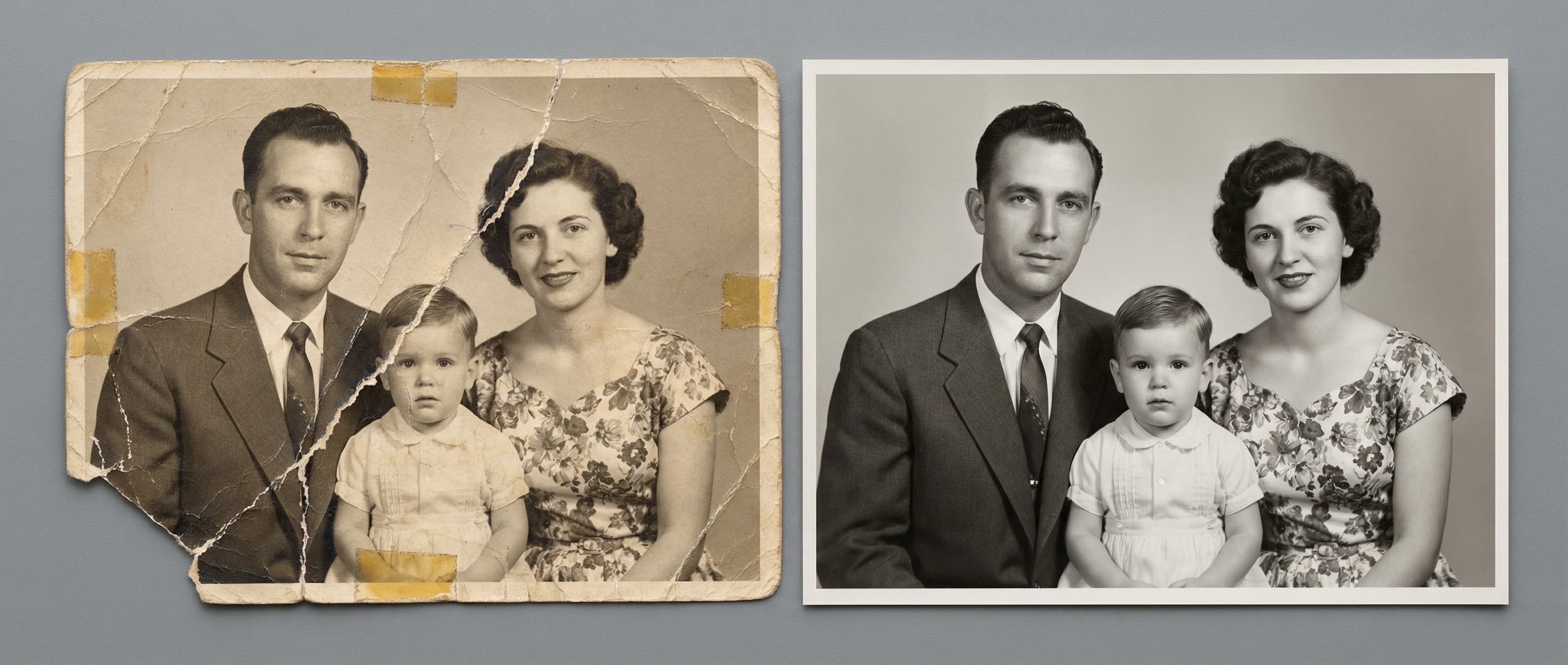
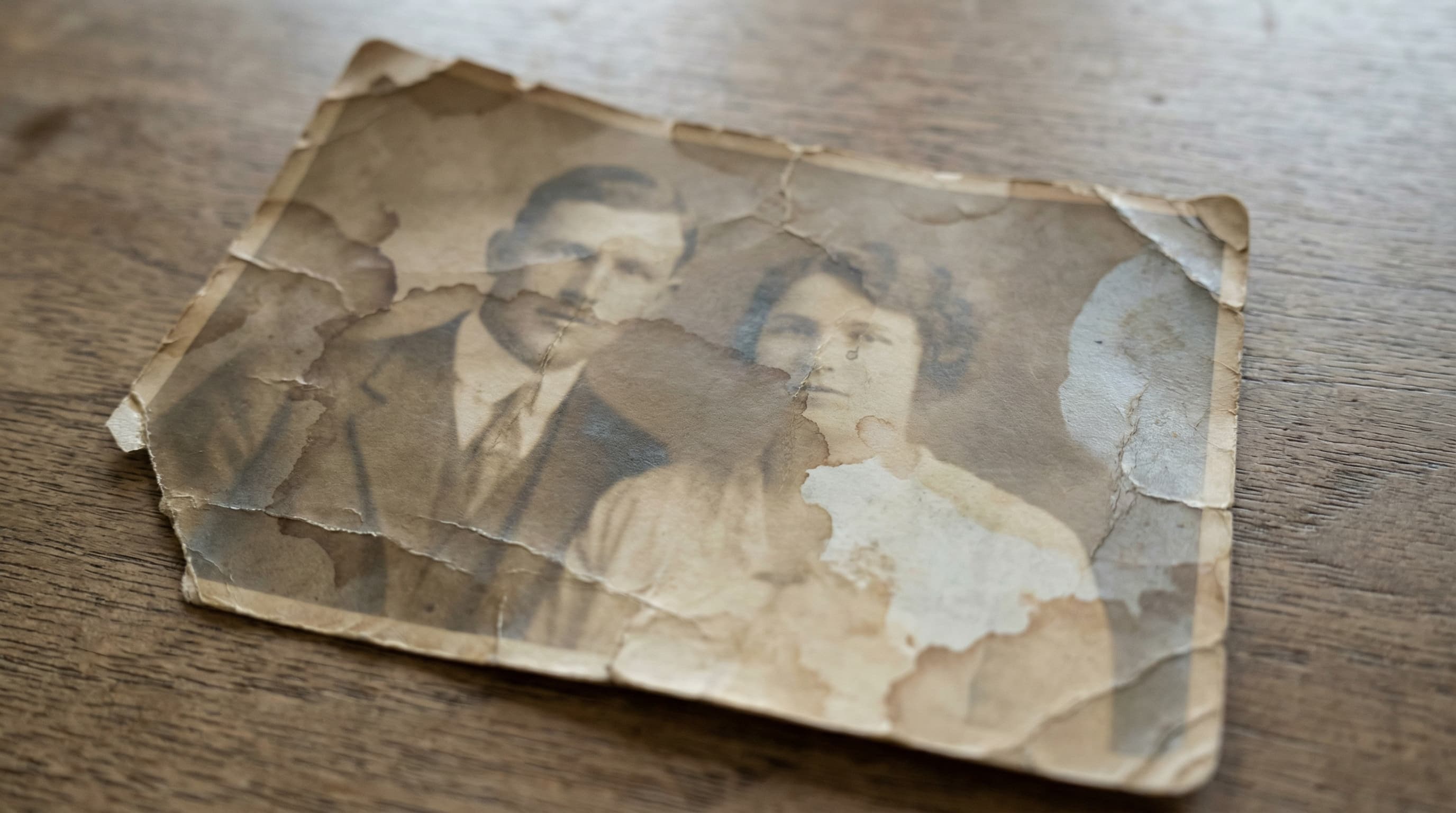
Tears range from small edge nicks to complete separations that divide an image into multiple pieces. Professional restoration handles these by digitally scanning each piece, aligning them precisely, and seamlessly blending the seam so it becomes invisible. When pieces are missing, the artist reconstructs the absent area using surrounding context — the pattern of a fabric, the gradient of a sky, the contour of a face.
The results are often remarkable. A photograph that was torn in half can look completely whole after restoration, with no visible evidence of the original damage.
Cracks and creases
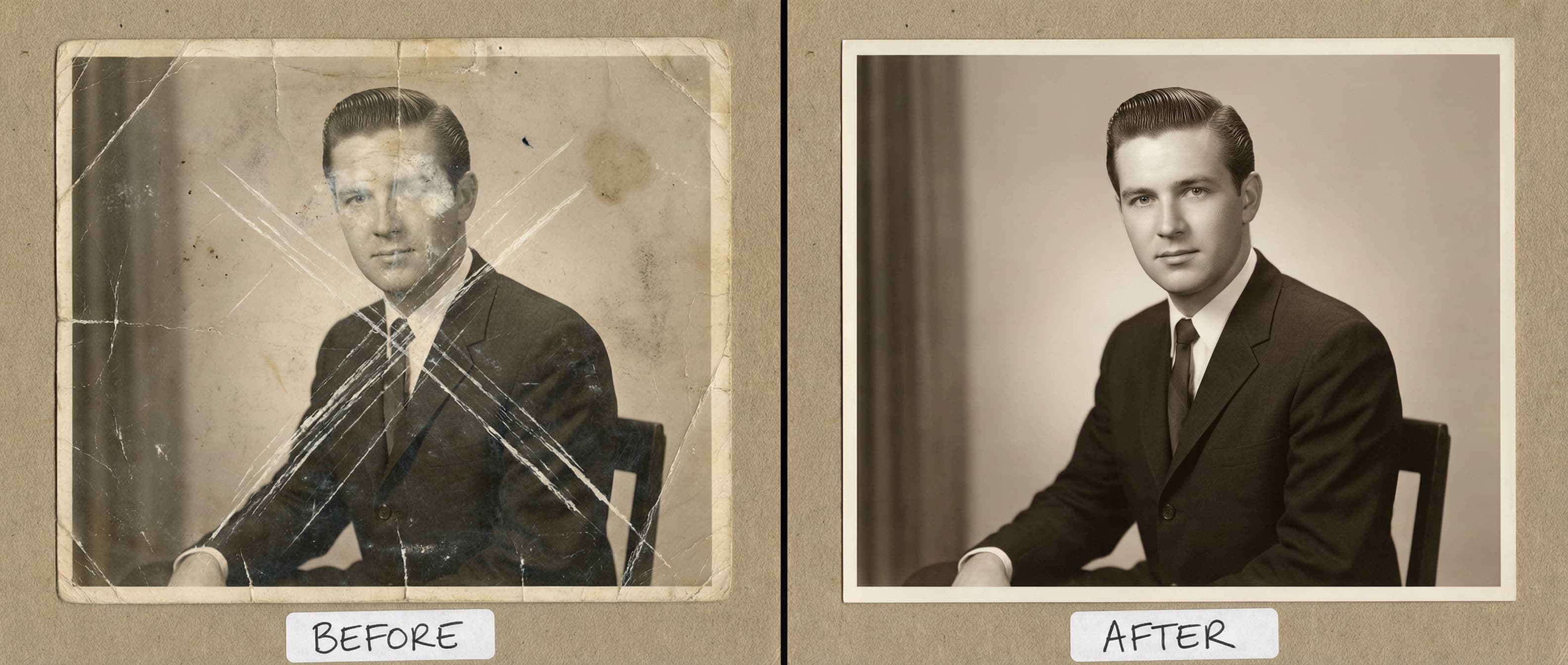
Cracks and creases are the most common form of physical damage. They appear as lines — sometimes white, sometimes dark — running across the image. Each crack disrupts the continuity of the photograph, and dense networks of cracks can make an image look almost shattered.
A restoration artist addresses each crack individually, carefully rebuilding the image data underneath. For straight, clean cracks, this is relatively efficient work. For branching, complex crack patterns, it is more labor-intensive. In either case, the end result is a smooth, uninterrupted image. Visit our photo restoration service page for examples.
Water stains and tidelines
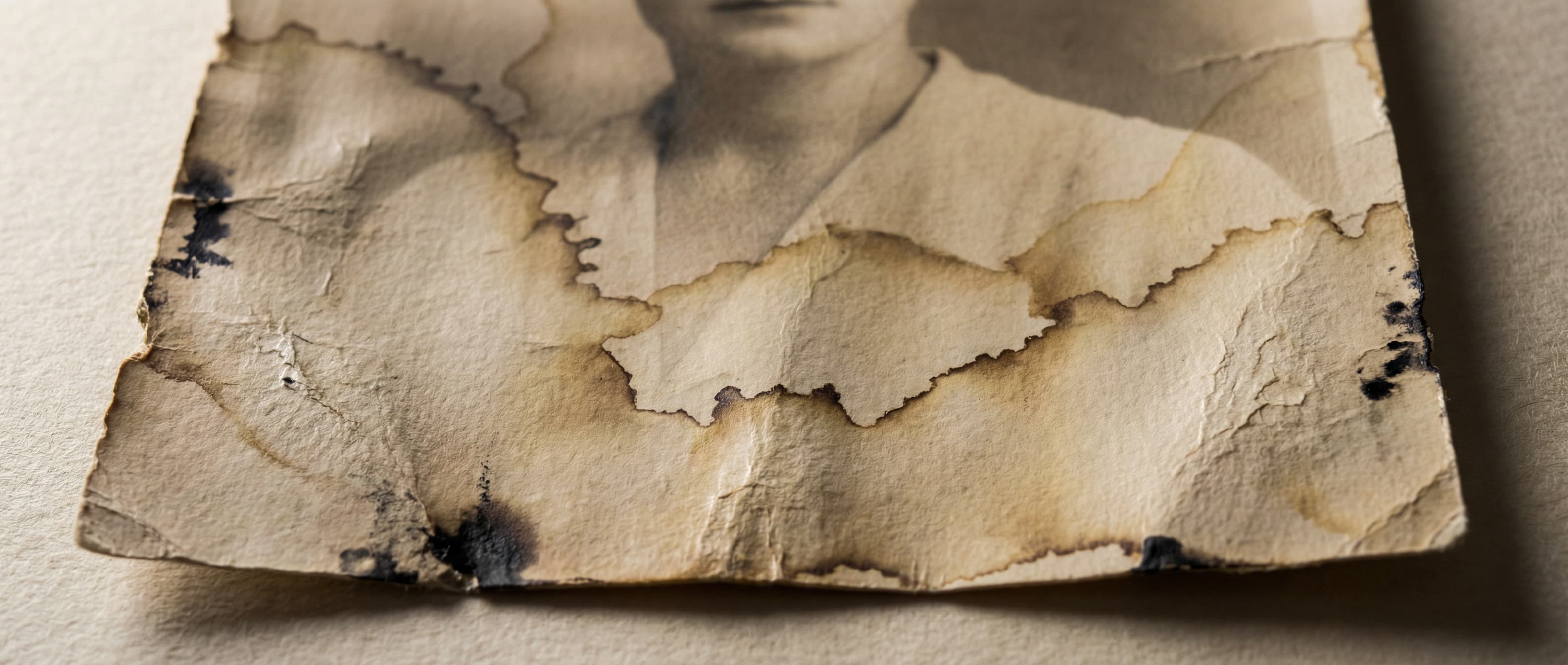
Water stains leave irregular, ring-like marks across the image, often with a distinct edge (called a tideline) where the water stopped. The discoloration can range from subtle to severe.
Digitally, water stains are corrected by separating the stain from the underlying image data. The artist adjusts the color and tone in the affected area to match the undamaged portions of the photograph. For mild stains, this produces perfect results. For severe staining where the image underneath has been compromised, some reconstruction may be needed.
Fading and discoloration
Time robs photographs of their original vitality. Colors shift, contrast diminishes, and the overall image takes on a flat, lifeless quality. Black-and-white photos lose their rich tonal range. Color photos may develop a strong magenta, yellow, or cyan cast.
This is one of the most gratifying types of restoration, because the transformation is dramatic. Correcting fading and color balance can make a photograph look as if it was printed yesterday, revealing details and depth that have been hidden for years. For a full walkthrough, see our complete restoration guide.
Scratches and abrasion
Surface scratches appear as fine lines, usually lighter than the surrounding image. They are caused by contact with other surfaces during storage, handling, or accidental brushing. While individually minor, a heavy accumulation of scratches can give a photograph a hazy, obscured appearance.
Professional restoration removes scratches with precision, restoring the clean, smooth surface of the original image. This is typically one of the faster and more straightforward repairs.
Mold and biological damage
Mold creates irregular spots and patches — sometimes fuzzy, sometimes flat — in white, green, black, or orange. Beyond the visible marks, mold can digest the gelatin emulsion that holds the image, causing permanent detail loss in affected areas.
If the mold has only stained the surface but left the image intact, restoration can remove the discoloration completely. If the mold has eaten into the emulsion, the artist must reconstruct the lost detail, which is similar to repairing missing sections from a tear.
When to Seek Professional Help
While it is useful to understand the types of damage and how they are repaired, the actual restoration work should be performed by someone with experience and the right tools. Here are situations where professional help is strongly recommended:
- The photograph is one-of-a-kind. If no duplicate or negative exists, the stakes are too high for experimentation.
- The damage involves faces. Facial reconstruction requires exceptional skill. Eyes, noses, mouths, and expressions are immediately recognizable to the human eye, and even minor inaccuracies will be obvious.
- Multiple types of damage are present. A photo with tears, fading, stains, and scratches simultaneously requires a coordinated approach from an experienced artist.
- You plan to print or frame the result. Restored images intended for display need to hold up to close inspection, which demands a higher level of quality.
- The photo has historical or genealogical significance. Family research photos, immigration portraits, military service photos, and other historically meaningful images deserve expert treatment.
At RestoredPast, we handle every type of damage described in this article. Our team works carefully on each image, with a satisfaction guarantee on every order. We also provide guidance on how much restoration costs so there are no surprises.
Protecting Your Photos Going Forward
Once your damaged pictures are repaired and digitized, take steps to prevent future damage:
- Store prints vertically in acid-free boxes rather than stacking them flat (stacking promotes sticking and surface damage).
- Use individual acid-free sleeves for each photograph.
- Control your environment. The ideal storage conditions are a stable temperature between 65 and 70 degrees Fahrenheit with 30 to 40 percent relative humidity. Avoid basements, attics, and garages, which experience temperature and humidity swings.
- Keep multiple digital copies in separate locations — a hard drive, a cloud service, and optionally a USB drive stored off-site.
- Never store photos in magnetic albums (the kind with sticky pages and a plastic overlay). The adhesive deteriorates over time and bonds with the photograph permanently.
Frequently Asked Questions
Can a photo that has been torn into many pieces be restored?
Yes. As long as most of the pieces are available, a restoration artist can digitally scan each piece, reassemble them like a puzzle, and blend the seams. Missing pieces can be reconstructed using contextual clues from the rest of the image.
What if my photo is stuck to the glass of a frame?
Do not try to pull it off — this will almost certainly destroy the image. A professional conservator can sometimes separate them using humidity chambers or careful techniques. Alternatively, you can scan the photo through the glass (the result will not be perfect, but it preserves the image data) and have the scan restored.
Should I attempt to clean a dirty photograph before scanning?
For loose dust or debris, a gentle brush with a clean, soft brush is fine. Do not use water, cleaning solutions, or cloths, as these can scratch or stain the surface. Let the restoration artist handle stains and discoloration digitally — it is far safer and more effective.
How do I scan a damaged photo that is curled or warped?
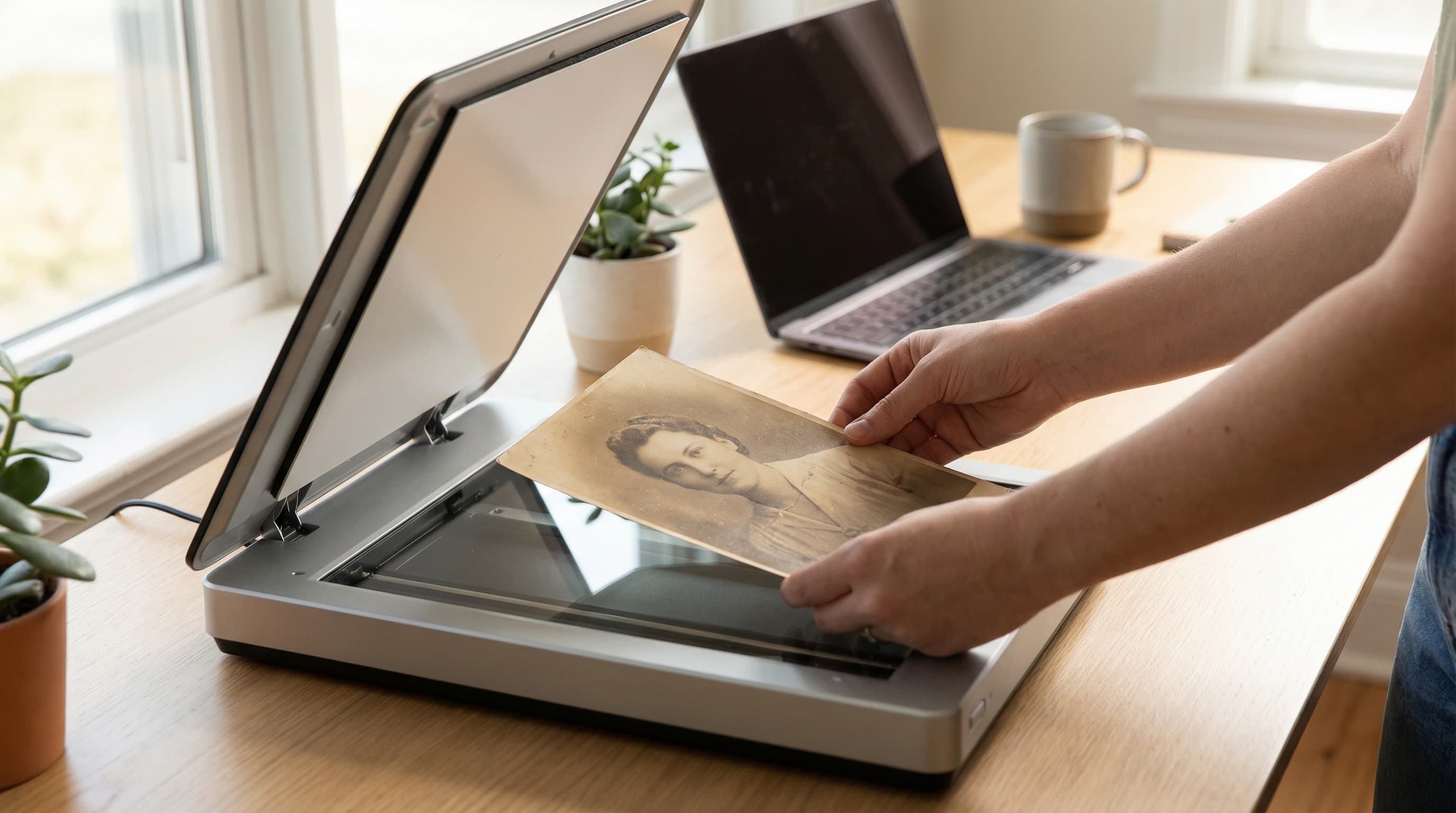
If the photo will lie reasonably flat on a scanner bed, it can be scanned directly. For severely curled photos, place a heavy (but clean) book on the scanner lid to apply gentle, even pressure. If the photo is too fragile to flatten, a conservator can help, or you can photograph it with a camera in controlled lighting.
Do Not Wait — Damage Gets Worse Over Time
Every type of photo damage is progressive. Fading continues. Cracks spread. Mold grows. The photograph you found today in damaged condition will be in worse condition a year from now, and worse still a decade from now. Digitizing and restoring your damaged pictures now preserves them at their current best — and gives future generations the clearest possible window into your family's past.